Best elk heads
The best crossbow broadheads for elk
An elk's shoulder is the hardest thing a crossbow bolt will hit. The head you want is thick, structurally simple, and sharpened to cut on contact.
String & Stock earns a commission when you buy through our links, at no extra cost to you. Prices come from Amazon and change; the date beside every price is when we last verified it. Full disclosure.
Ranked
Quick picks
| # | Product | Blades | Score | Price |
|---|---|---|---|---|
| Rank 1 | Magnus Black Hornet Ser-Razor 4-Blade | 4, fixed | 8.8 | $42.98Amazon |
| Rank 2 | 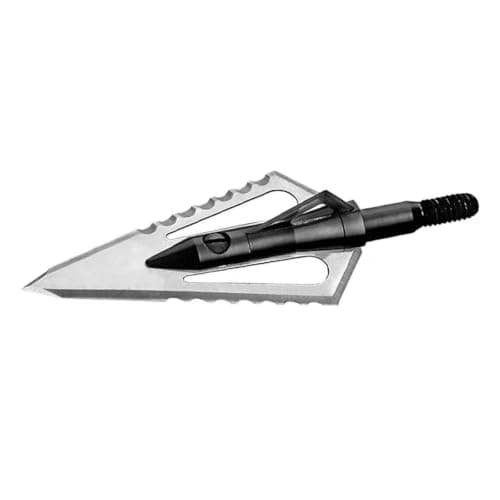 Magnus Stinger Buzzcut 4-Blade 125 gr | 4, fixed | 8.2 | $44.02Amazon |
| Rank 3 | 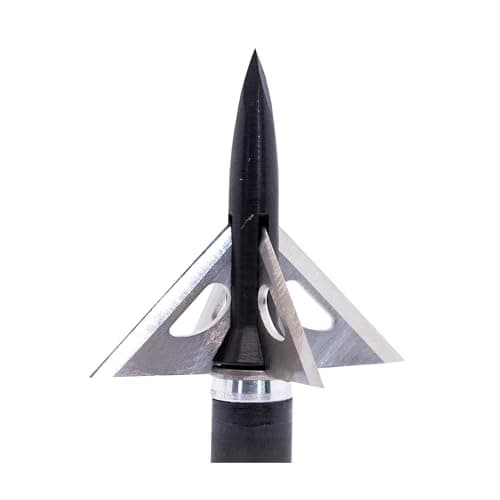 Slick Trick GrizzTrick Pro Series | Stainless Lutz, 4 | 8.7 | $49.31Amazon |
| Rank 4 | 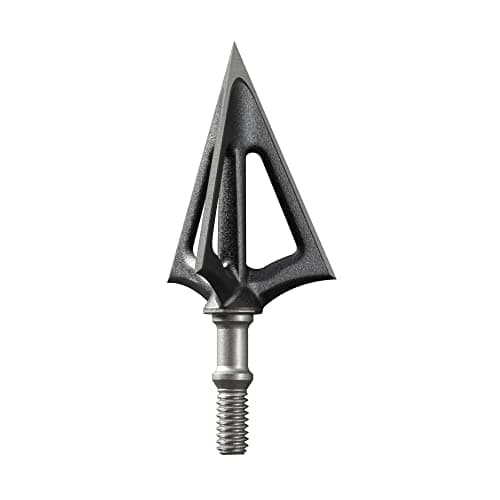 TenPoint EVO-X Montec | 3, fixed | 8.8 | $44.99Amazon |
| Rank 5 | 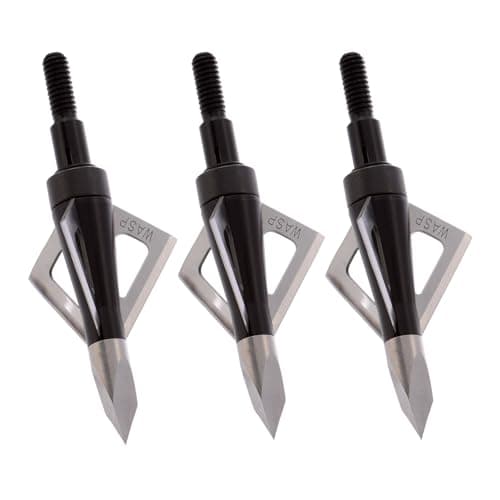 Wasp Boss SST 3-Blade | 3, fixed | 8.3 | $44.99Amazon |
The best crossbow broadhead for elk is the Magnus Black Hornet Ser-Razor 4-Blade: a 0.059-inch main blade, the thickest published figure on this site, with a cut-on-contact tip, four blades and user-replaceable main blades. For an animal with heavy shoulder bone, blade thickness and ferrule strength matter more than cutting diameter.
Elk are roughly four times the body mass of a whitetail, with a deep chest cavity and shoulder bone that is genuinely heavy. That combination inverts the broadhead logic most crossbow hunters learn on deer. On a whitetail, a wide mechanical that opens a big hole is a reasonable choice because penetration is rarely the limiting factor. On an elk, penetration is the only thing that matters, and every mechanism that can bend, deflect or fail under impact is a liability.
So this page is fixed heads only, and the ranking is structural: published blade thickness first, then blade count and ferrule construction, then cut. Mechanicals are not here - not because they cannot kill an elk, but because a head that spends energy deploying at the moment of impact is the wrong tool for bone. The honest version of that argument is on mechanical vs fixed blade.
In detail
Five heads for heavy bone
Magnus Black Hornet Ser-Razor 4-Blade
A .059-inch main blade with .040-inch bleeders, serrated, cut-on-contact, made in the USA and backed by the Magnus lifetime guarantee. That main blade is the thickest published figure of any broadhead on this site, which is the whole argument for it: if you expect to hit a shoulder, thickness is what survives the contact. The cut is modest by four-blade standards at 1-5/16 by 1-1/4 inches.
| Published spec | Value |
|---|---|
| Weight | 100 gr |
| Main blade thickness | 0.059 in |
| Bleeder blade thickness | 0.040 in |
| Cut | 1-5/16 in x 1-1/4 in |
| Blades | 4, fixed |
| Edge | Serrated, precision-ground |
| Tip | Cut-on-contact |
| Maintenance | User-sharpenable and replaceable main blades |
| Warranty | Magnus Lifetime Guarantee |
| Origin | Made in the USA |
| Per pack | 3 |
What it does well
- A .059 in main blade is the thickest published figure on this site
- Serrated edges, which Magnus credits with larger blood trails
- Sharpenable and replaceable blades rather than a disposable head
- Lifetime guarantee and US manufacture
Where it falls short
Our rubric
- 8.4
- 9.2
- 8.6
- 9.4
- 8.8
Magnus Stinger Buzzcut 4-Blade 125 gr
A chisel-cut serrated main blade across four blades at 125 grains. Serrations tear rather than slice, which is a deliberate choice aimed at blood trails rather than clean penetration. At 125 grains it is the heavier option for a heavy-bolt setup.
| Published spec | Value |
|---|---|
| Weight | 125 gr |
| Blades | 4, fixed |
| Main blade | Chisel-cut serrated |
| Type | Fixed |
| Patent | US 7,160,217 |
| Per pack | 3 |
| Cutting diameter |
What it does well
- Serrated main blade is aimed squarely at blood trails
- Four blades at 125 grains for a heavy front-of-center setup
- A long production record behind the Stinger line
Where it falls short
Our rubric
- 7.8
- 8.6
- 8.0
- 9.0
- 8.2
Slick Trick GrizzTrick Pro Series
Four .035-inch stainless Lutz blades in a short Super Steel ferrule giving 2-1/2 inches of total cut, held by the Alcatraz blade lock. Short, fat and fixed: it flies like a field point because there is barely any ferrule forward of the blades to plane in the wind.
| Published spec | Value |
|---|---|
| Weight | 100 gr |
| Total cut | 2-1/2 in (1-1/4 in + 1-1/4 in) |
| Blade thickness | 0.035 in |
| Blades | Stainless Lutz, 4 |
| Ferrule | Super Steel |
| Blade lock | Alcatraz |
| Tip |
What it does well
- 2-1/2 inches of total cut is the widest fixed-head figure here
- A short ferrule means less wind planing
- Alcatraz blade lock keeps blades seated through bone
- Blades are replaceable rather than the whole head
Where it falls short
Our rubric
- 8.4
- 9.0
- 8.8
- 9.0
- 8.2
TenPoint EVO-X Montec
Built for TenPoint by G5, which is to say it is a Montec specified for high-speed crossbows: 100 grains, three fixed blades, a 1-1/8 inch cut, one-piece MIM construction and a 100 percent steel ferrule. If you shoot a fast bow and want a fixed head, this is the one that was designed for the application.
| Published spec | Value |
|---|---|
| Weight | 100 gr |
| Cutting diameter | 1-1/8 in |
| Blades | 3, fixed |
| Construction | One-piece MIM, 100% steel ferrule |
| Designed for | High-speed crossbows |
| Sharpening | Diamond cut |
| Per pack | 3 |
What it does well
- Specified for high-speed crossbows, not adapted from a compound head
- One-piece construction with nothing to come loose
- Made by G5, whose Montec is the reference fixed head
Where it falls short
Our rubric
- 8.4
- 9.4
- 9.0
- 9.4
- 8.0
Wasp Boss SST 3-Blade
A low-profile fixed head with a stainless trocar tip hardened to Rockwell 46C and hollow ground, and .027-inch blades ground to line up exactly with the tip edges — which is the detail that determines whether a head penetrates or deflects. A 1-1/8 inch cut from an aerodynamic aluminum ferrule.
| Published spec | Value |
|---|---|
| Weight | 100 gr |
| Cutting diameter | 1-1/8 in |
| Blade thickness | 0.027 in |
| Blades | 3, fixed |
| Tip | Stainless trocar, Rockwell 46C, hollow ground |
| Ferrule | Short aerodynamic aluminum |
| Origin | Made in the USA |
What it does well
- Blades aligned to the tip edges, which is what drives penetration
- A published tip hardness figure, which almost nobody states
- Low-profile ferrule flies like a field point
Where it falls short
Our rubric
- 8.6
- 8.4
- 8.4
- 7.8
- 8.0
How we picked
Published main-blade thickness first, because that is the figure that predicts whether a blade survives bone. Then blade count and whether the main blades are replaceable, because an elk hunt is often a long way from a shop. Then the tip: a cut-on-contact tip starts the hole, a chisel tip punches it, and on heavy bone the difference is real. Our scoring axes are on the methodology page.
The structural table
| Head | Grain | Blades | Published blade thickness | Tip |
|---|---|---|---|---|
| Magnus Black Hornet Ser-Razor | 100 gr | 4, fixed | 0.059 in main, 0.040 in bleeder | Cut-on-contact |
| Magnus Stinger Buzzcut 4-Blade | 125 gr | 4, fixed | Chisel-cut serrated main blade | |
| Slick Trick GrizzTrick Pro | 100 gr | 4, Stainless Lutz | 0.035 in | |
| TenPoint EVO-X Montec | 100 gr | 3, fixed | One-piece MIM, diamond cut | |
| Wasp Boss SST | 100 gr | 3, fixed | 0.027 in | Stainless trocar, Rockwell 46C |
Why thickness beats cutting diameter here
A broadhead has a fixed amount of energy to spend, and it spends it on three things: pushing the ferrule through tissue, cutting with the blades, and surviving whatever it hits. A wider cut spends more on the second and leaves less for the first. On a deer that trade is usually worth making. On an elk it is not, because the thing you are trying to get through is not tissue.
Blade thickness is the figure that predicts survival. The Magnus Black Hornet publishes 0.059 in on the main blade, the Slick Trick 0.035 in, the Wasp 0.027 in. Those are not small differences in a part that has to stay flat when it hits a scapula. The same argument drives best fixed blade broadheads, which ranks the whole fixed category on this figure.
The arrow decides as much as the head
Kinetic energy rises with arrow mass as well as speed, which is why a 400 fps bow throwing a heavy shaft can carry more energy to an elk than a 450 fps bow throwing a light one. Wicked Ridge's own published figures make the point: 146 ft-lb for a 400 fps bow quoted with a 410 gr arrow, 138 ft-lb for a faster bow quoted with a 370 gr one. Buy the heavy end of your bow's range. The full reasoning is on crossbow kinetic energy and the shaft selection is on best crossbow bolts for elk.
100 or 125 grain?
For elk specifically, 125 gr is a defensible choice where it is for almost nothing else. Moving from 100 gr to 125 gr adds mass at the front of the arrow, which raises front-of-center and total arrow weight at once - both of which help penetration. The cost is a slightly steeper trajectory and a re-zero. The Magnus Stinger Buzzcut on this page is the 125 gr option. The full trade, including why most crossbow bolts are sold set up for 100 gr, is on 100 vs 125 grain broadheads.
What the top three are each for
Magnus Black Hornet Ser-Razor 4-Blade
0.059 in on the main blade and 0.040 in on the bleeder, a 1-5/16 x 1-1/4 in cut, a cut-on-contact tip, serrated precision-ground edges, and main blades that are both user-sharpenable and replaceable. Magnus is made in the USA and backs the head with its lifetime guarantee. If you are going to shoot one broadhead at one elk, this is the one we would send.
Magnus Stinger Buzzcut 4-Blade 125 gr
The 125 gr answer, with four fixed blades and a chisel-cut serrated main blade. Magnus does not publish a blade-thickness figure for it, which is why it sits second rather than first, but the construction and the weight are both pointed at exactly this animal. If you are already shooting a heavy arrow and want more front-of-center, this is the simplest way to get it.
Slick Trick GrizzTrick Pro Series
2-1/2 in of total cut from two pairs of 1-1/4 in blades at 0.035 in thickness, on a Super Steel ferrule with the Alcatraz blade lock. It is the most total cut on this page from a head that is still built like a fixed head should be, which makes it the pick if you want a bigger wound channel without going anywhere near a mechanism.
Our pick
The Magnus Black Hornet Ser-Razor, on the published blade thickness alone - nothing else here is close, and on an elk that number is the one that decides whether the blade is still flat after the scapula. The Stinger Buzzcut is the pick if you want 125 gr to raise front-of-center. The TenPoint EVO-X Montec is the pick if you would rather have a one-piece head with literally nothing to loosen, and it is specified for crossbow speed by the company that builds the bows.
What we would not shoot at an elk
- Any mechanical head. It spends energy opening at the exact moment you need it driving forward.
- A head with no published blade thickness, if you have a choice. Two heads on this page do not publish one and we have said so; a third option that does is worth preferring.
- A light arrow. Bottom-of-range arrow weight is the wrong end for heavy bone. See crossbow bolt weight.
- A field-point zero only. Broadheads fly differently. Confirm the zero with the head you will hunt - how to sight in a crossbow with broadheads covers the procedure.
- Package broadheads. The heads that ship with a crossbow are practice points in all but name.
Practice with them, on a target that will take them
Fixed heads built this heavily do not fly identically to field points, and the only way to know your arrow's actual point of impact at 40 yards is to shoot the head you will hunt with. That needs a target rated for broadheads, because a bag target will be destroyed by a 0.059 in four-blade head in a dozen shots. Best broadhead targets lists the ones built for it, and best targets for high-fps crossbows covers the speed rating you also need to clear.
Frequently asked questions
What is the best broadhead for elk with a crossbow?
Should you use mechanical broadheads for elk?
What grain broadhead is best for elk?
How much penetration do you need for elk?
Are crossbows legal for elk hunting?
Sources
Read next
Bolts & Broadheads
The best crossbow bolts for elk
Bolts & Broadheads
The best fixed blade crossbow broadheads
Bolts & Broadheads
100 vs 125 grain broadheads