Best Block target
Block crossbow targets, by published speed rating
Block's range used to split on one figure. It no longer does. Every PolyFusion model that published a speed rating has gone, and the two Classic targets left publish none at all.
String & Stock earns a commission when you buy through our links, at no extra cost to you. Prices come from Amazon and change; the date beside every price is when we last verified it. Full disclosure.
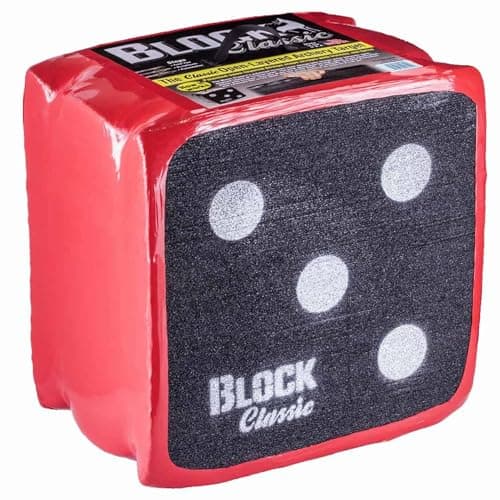
Block Classic
The original open-layered Block: arrows stop with friction rather than force, entering between unglued layers that grip the shaft as it heats and release it as it cools.
Ranked
Quick picks
| # | Product | Speed rating | Score | Price |
|---|---|---|---|---|
| Rank 1 | Block Classic | 9.2 | $77.50Classic | |
| Rank 2 | Block Classic 22 | 9.1 | $119.99Classic 22 |
There is no longer a Block target with a published crossbow speed rating. Every PolyFusion model that carried one - the crossbow-specific Infinity 20, the standard Infinity 20 and 22, and the 6x6 - now reads Currently unavailable, leaving the Classic 18 and Classic 22. Both are sold for field points and broadheads, and neither publishes a speed figure, so on a fast bow they are an unknown rather than a yes.
Block is one of the two or three target names a crossbow buyer actually types, which is why this page exists. The honest state of the range as of November 2026 is narrower than it was: the rated, six-sided PolyFusion targets have gone and the open-layer Classic is what remains. That is not a small change for a crossbow shooter, because the speed rating was the only part of Block's specification that answered the question you came here with.
What follows is the live range, what the discontinued models published while they were sold, and where to go instead if your bow needs a number on the box. If it does, start with the best targets for a high-FPS crossbow - the Rinehart 18-1 publishes 500 fps and the SpyderWeb 20XL publishes no limit at all.
In detail
The two Block targets a crossbow shooter can still buy
Block Classic
The original open-layered Block: arrows stop with friction rather than force, entering between unglued layers that grip the shaft as it heats and release it as it cools. That mechanism is why the Block pulls easier than a solid-foam target. 18 by 18 by 13.5 inches, two-sided, high-contrast faces.
| Published spec | Value |
|---|---|
| Dimensions | 18 x 18 x 13.5 in |
| Faces | 2 |
| Technology | Patented open-layered friction design |
| Arrow removal | Heat and friction grip, then release on cooling |
| Faces detail | High-contrast black and white |
| Carry | Lightweight and portable |
| Speed rating |
Why we recommend it
- The open-layer design gives the easiest pull of the foam targets here
- An 18-inch two-sided face
- Light enough to take to camp
Good to know
No speed rating published, which is a real gap for a fast bow
Our rubric
- 8.8
- 9.8
- 9.4
- 8.8
- 9.4
Block Classic 22
The big Classic: 22 by 22 by 13.5 inches of open, unglued friction layers, two-sided, with the high-contrast black-and-white layout. The friction mechanism is the reason a Classic pulls easier than solid foam — the shaft is gripped by heat and released as it cools. What Block does not publish for the Classic line is a speed rating, and on a crossbow page that omission is the headline, not a footnote.
| Published spec | Value |
|---|---|
| Dimensions | 22 x 22 x 13.5 in |
| Faces | 2 |
| Technology | Patented open-layered friction design |
| Arrow removal | Heat and friction grip, then release on cooling |
| Faces detail | High-contrast black and white, reversed layout |
| Also sold as | Classic 18, at 18 x 18 x 13.5 in |
| Carry | Top carry handle |
| Speed rating |
Why we recommend it
- A 22-inch face, the largest Classic size
- The friction-layer design pulls easier than solid foam
- Light enough to move between the yard and the truck
- Costs well under the Infinity models
Good to know
No speed rating published, which is the whole decision on a fast bow
Our rubric
- 8.8
- 9.8
- 9.0
- 8.8
- 9.3
How we picked
Published speed rating first, exactly as on the best crossbow targets. Then what the rating covers - field points only, or fixed and expandable broadheads too. Then face size, because a bigger face is how a target survives a tight group. Nothing here is our own measurement; every figure is Block's own published claim and we say so. See our methodology.
The live Block range, side by side
| Model | Published rating | Dimensions | Faces | Broadheads |
|---|---|---|---|---|
| Classic 18 | 18 x 18 x 13.5 in | 2 | Field points and broadheads | |
| Classic 22 | 22 x 22 x 13.5 in | 2 | Field points and broadheads |
What has gone, and what it published
These four are listed because the demand for them has not gone anywhere, and because knowing what they published is how you judge a replacement. All four now read Currently unavailable.
| Discontinued model | Published rating | Dimensions | Faces | Broadheads |
|---|---|---|---|---|
| Infinity Crossbow 20 and 16 | Up to 520 fps | 20 and 16 in | 6 | Fixed and expandable |
| Infinity 22 | Up to 500 fps | 22 x 22 x 16 in | 6 | Fixed and expandable |
| Infinity 20 | Up to 500 fps | 20 in | 6 | Fixed and expandable |
| 6x6 | Up to 400 fps | 18 x 18 x 16 in | 6 | Field points and broadheads |
The two Block mechanisms, and why they behave differently
Open-layer friction: the Classic
The original Block stops an arrow between open, unglued layers of friction foam. The shaft parts the layers, heat from the penetration plus friction grips it, and as the heat dissipates in a few seconds the grip releases. That is a genuinely clever mechanism and it is the reason a Classic pulls easier than a solid-foam target - you are not fighting compressed foam, you are waiting a moment for it to let go.
It is also a mechanism whose limit depends on how much energy arrives, which is presumably why Block does not put a number on it. For a compound bow that is fine. For a crossbow it leaves you guessing, and the thing you would be guessing about is whether a bolt exits the back of the target.
PolyFusion: the Infinity, while it lasted
The Infinity line wrapped a high-density layered-foam inner core in an exterior foam wall. The core did the stopping and the wall held the core together, which addressed the classic failure of layered targets - the stack separating after a few hundred shots. That construction is what let Block publish 500 fps on the Infinity 22, 520 fps on the crossbow-specific model and 400 fps on the smaller 6x6, and guarantee all of them for fixed and expandable broadheads rather than field points only.
It is written in the past tense because none of those models is on sale. If that construction is what you were looking for, the nearest live equivalents are not Block: Rinehart's self-healing foam seals the hole behind the arrow and publishes 500 fps, and the SpyderWeb 20XL's woven mesh publishes no speed limit at all. Both are ranked on the best targets for a high-FPS crossbow.
Match the Block to your bow
| Your bow's published speed | What to buy now | Why |
|---|---|---|
| Up to 390 fps, field points | Classic 22 | The easiest arrow pull of anything with the Block name, and a 22-inch face. No rating, so treat 390 fps as the practical ceiling |
| Up to 390 fps, broadheads | Rinehart 18-1 instead | The Classic is sold for broadheads but publishes no speed figure; the Rinehart publishes 500 fps and names expandables |
| 390 to 450 fps | Not a Block | Nothing in the live Block range publishes a figure to check your bow against - see the high-fps page |
| Over 450 fps | Rinehart 18-1 or SpyderWeb 20XL | 500 fps published, and no stated limit, respectively |
| Small-diameter arrows at any speed | Not on a published rating | Speed guarantees are written for standard-diameter bolts |
If your bow is above 450 fps the shortlist gets very short very quickly, and it stops being a Block-only question. The best targets for a high-FPS crossbow ranks everything on this site that publishes a figure in that class, including the two non-Block targets that clear 500 fps.
Face size does more than you think
A crossbow is accurate enough that practice groups land in one place, and one place is exactly where a foam target fails first. Twenty or thirty bolts into a four-inch cluster chews a hole the next bolt passes straight through, regardless of what the target is rated for. Two things defend against it: more shootable faces, and face designs whose aiming points are offset rather than repeated, so rotating the target moves your group instead of stacking it.
This is where the Classic is weakest and where the retired six-sided models were strong. A Classic gives you two faces and one layout, so the wear concentrates about three times faster than it did on a six-face cube. It is also the clearest argument for the bigger Classic 22 over the Classic 18: four extra inches in each direction is not about missing, it is about having somewhere else to aim at 40 yards once the middle of face one is finished. If face count is what you are shopping for, the Rinehart 18-1's eighteen faces are the live answer.
Arrow pull, and the one place the Classic wins
The Classic's friction mechanism genuinely pulls easier than compressed solid foam. If you shoot high volume with field points, in the yard, from a bow under about 390 fps, the Classic is a pleasant target and the easiest arrow removal of anything with the Block name. That is a deliberately narrow recommendation, and it is the whole case for the target: it holds for field points at moderate speed and it stops holding the moment you screw a broadhead on or buy a faster bow.
For the wider market comparison, bag versus block targets sets out why a bag is usually the easier pull and the worse choice for broadheads, and the best lightweight crossbow targets covers the weight question if you carry a target out to the back fence.
How long a Block lasts, and what finishes one early
Nobody publishes a shot count, and any maker that did would be guessing at your habits rather than measuring its foam. What is predictable is the failure order. The center of whichever face you favor goes first, because that is where the group lands. Then the layer structure behind it loosens, which on a Classic shows up as the stack starting to part. That is not a defect; it is the foam doing its job until it has done it enough times.
Three habits extend it more than the model choice does. Rotate the faces on a schedule rather than when you notice - with two faces that matters more, not less. Practice with field points and save broadheads for the handful of confirmation shots before the season, because a broadhead cuts the foam rather than parting it. And bring it inside, or at least under cover: Block states weather resistance, not weatherproofing, and a target that has been rained through stops arrows differently from a dry one. The same logic as crossbow maintenance applies - the consumable you ignore is the one that fails at the wrong moment.
Where to put it, and what goes behind it
A foam cube is a small target with a hard edge, and a crossbow at 400 fps punishes both facts. Two things are worth setting up properly before the first shot. The first is a backstop: assume at some point a bolt will pass the target, either because you clipped the edge or because the center of that face was more worn than you thought, and put something behind it that you are willing to put a bolt into. The second is the shooting distance. Sight in at the range you will actually shoot - how to sight in a crossbow covers the procedure, and a 20 in face is generous at 20 yards and small at 50.
One Block-specific note on placement: these are light targets relative to the energy arriving, so they move. A cube that walks back a foot per volley changes your distance without telling you, and a cube that tips over mid-session is how a face gets scuffed. Put it against something solid or weight the base.
What Block does not sell
- A rated bag target. Block's range is foam. If you want a bag rated for crossbow speed, that is a different maker entirely.
- A speed-rated target, any more. Every Block model that published a crossbow speed figure has been discontinued. That is the single most important line on this page.
- A six-sided target. Both live Classic models are two-sided, so face rotation is a far weaker defense than it was on the PolyFusion cubes.
- A published weight. Neither Classic publishes a weight figure despite shipping with a carry handle, which is a gap if you plan to move one daily.
- A small-diameter arrow guarantee. Covered above, and worth repeating because it is the most common way a correct-looking purchase turns out wrong.
Our pick
The Block Classic 22 if you want a Block, shoot field points, and your bow is at the moderate end - it is the biggest live face in the range and the easiest arrow pull of anything with the Block name. The Classic 18 if the smaller cube is easier to move and store. And honestly: if you need a published speed rating, this is no longer the brand to buy it from. The rated PolyFusion models have gone, and the live Classics answer a different question. The best targets for a high-FPS crossbow ranks what is left that publishes a figure.
Whatever you buy, the target is half the setup. A broadhead that opens in flight wrecks a target face early, and the arrow you practice with should weigh what the arrow you hunt with weighs - broadheads for 400 fps bows and crossbow bolt weight both matter more to target life than the brand on the foam.
Frequently asked questions
Will a Block target stop a crossbow bolt?
What happened to the Block Infinity 22?
What happened to the Block 6x6?
What happened to the Block Infinity Crossbow 20?
Can you shoot broadheads into a Block target?
Is a Block target good for a 400 fps crossbow?
Why is my bolt going all the way through my Block target?
Are Block targets made in the USA?
Our recommendation
Sources
Read next
Targets & Cases
The best crossbow targets
Targets & Cases
The best targets for a high-FPS crossbow
Targets & Cases
Bag vs block targets
Targets & Cases
Will a crossbow shoot through a target?
Targets & Cases
The best broadhead targets for crossbows