Best 4-blade
The best 4-blade broadheads for crossbows
A fourth blade buys you a bigger hole and costs you penetration. Here is what each of the five four-blade designs on this site actually publishes.
String & Stock earns a commission when you buy through our links, at no extra cost to you. Prices come from Amazon and change; the date beside every price is when we last verified it. Full disclosure.
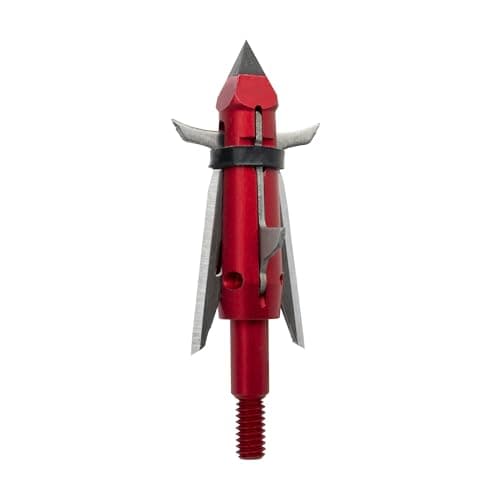
Ranked
Quick picks
| # | Product | Blade count | Score | Price |
|---|---|---|---|---|
| Rank 1 | TenPoint Nemesis | 4, expandable | 8.5 | $59.99Amazon |
| Rank 2 | 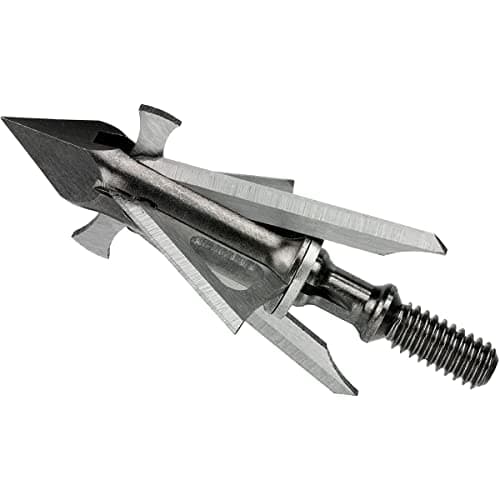 Muzzy Trocar HBX Hybrid | 4 (2 fixed, 2 mechanical) | 8.3 | $43.37Amazon |
| Rank 3 | 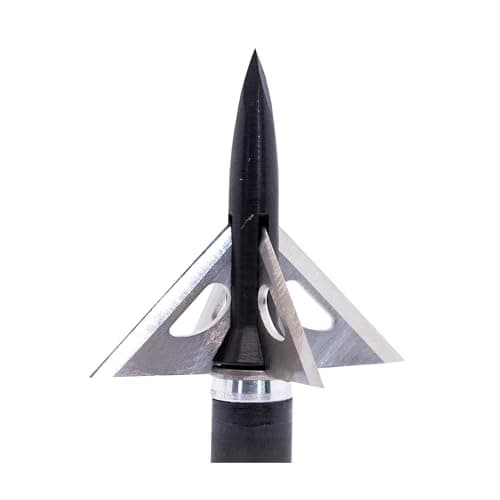 Slick Trick GrizzTrick Pro Series | Stainless Lutz, 4 | 8.7 | $49.36Amazon |
| Rank 4 | 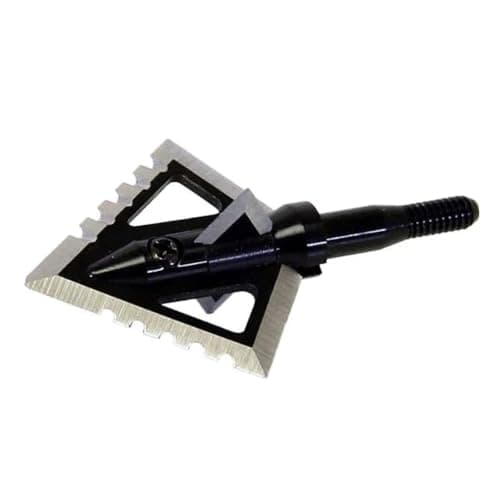 Magnus Black Hornet Ser-Razor 4-Blade | 4, fixed | 8.8 | $42.98Amazon |
| Rank 5 | 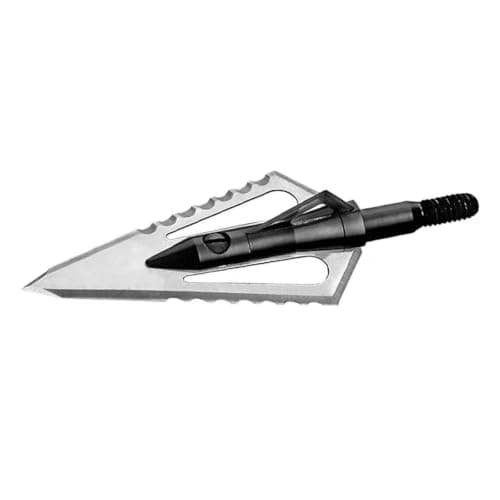 Magnus Stinger Buzzcut 4-Blade 125 gr | 4, fixed | 8.2 | $44.24Amazon |
For a crossbow, the widest four-blade cut published here is the TenPoint Nemesis at 3.75 inches total, tested to 900 fps. The thickest blade is the Magnus Black Hornet Ser-Razor at .059 inch. The widest fixed-blade cut is the Slick Trick GrizzTrick at 2-1/2 inches. Which one is right depends on how fast your bow is.
A four-blade broadhead is a specific trade, and the trade is not subtle. Two extra cutting edges make a bigger, faster-bleeding wound channel and give you a second blade orientation on a marginal hit — which is the real argument, because a two-blade head that arrives at a bad angle can slip between ribs in a way a four-blade head cannot. What you pay for that is frontal area: more blade facing forward means more resistance, and resistance costs penetration.
Crossbows are the platform where that trade works out best, because crossbow velocity gives you energy to spend. A 400 fps bow throwing a 400 gr arrow has budget for a wide cut that a 330 fps youth compound simply does not. That is why several of these heads are either built by crossbow manufacturers or rated for crossbow speeds specifically.
In detail
Five four-blade heads
TenPoint Nemesis
A four-blade expandable built by a crossbow-only manufacturer, and the numbers are unlike anything else on this site: a two-blade 2-inch entry wound plus a four-blade 2 x 1.75-inch exit, which TenPoint totals at 3.75 inches of cut. It publishes a 900 fps test figure, so no crossbow you can buy will out-run it. You pay for all of that, and it is a mechanical, so it spends energy opening.
| Published spec | Value |
|---|---|
| Weight | 100 gr |
| Total cut | 3.75 in (2 in entry + 2 x 1.75 in exit) |
| Blades | 4, expandable |
| Entry wound | Two-blade, 2 in |
| Exit wound | Four-blade, 2 x 1.75 in |
| Tested to | 900 fps |
| Type | Mechanical, expandable |
| Per pack | 3 |
What it does well
- 3.75 in of published total cut is the widest figure on this site
- Tested to 900 fps, which no crossbow sold can approach
- Built by a crossbow manufacturer rather than rated down from a compound head
- Four blades on the exit hole, which helps on a marginal hit
Where it falls short
Our rubric
- 8.6
- 8.0
- 9.0
- 8.2
- 7.4
Muzzy Trocar HBX Hybrid
Four blades: two fixed, two mechanical, with the fixed pair offset to induce spin. It is a genuine middle path — the fixed blades cut on contact and the mechanicals widen the channel, and the chisel tip and stainless ferrule are built to survive bone.
| Published spec | Value |
|---|---|
| Weight | 100 gr |
| Blades | 4 (2 fixed, 2 mechanical) |
| Type | Hybrid |
| Tip | Chisel |
| Ferrule | Stainless steel |
| Design note | Offset fixed blades induce spin |
| Cutting diameter |
What it does well
- Fixed blades cut on contact even if the mechanicals do not open
- Offset fixed blades stabilize the arrow in flight
- A stainless ferrule and chisel tip for bone
Where it falls short
Our rubric
- 8.0
- 8.6
- 8.2
- 8.8
- 8.2
Slick Trick GrizzTrick Pro Series
Four .035-inch stainless Lutz blades in a short Super Steel ferrule giving 2-1/2 inches of total cut, held by the Alcatraz blade lock. Short, fat and fixed: it flies like a field point because there is barely any ferrule forward of the blades to plane in the wind.
| Published spec | Value |
|---|---|
| Weight | 100 gr |
| Total cut | 2-1/2 in (1-1/4 in + 1-1/4 in) |
| Blade thickness | 0.035 in |
| Blades | Stainless Lutz, 4 |
| Ferrule | Super Steel |
| Blade lock | Alcatraz |
| Tip |
What it does well
- 2-1/2 inches of total cut is the widest fixed-head figure here
- A short ferrule means less wind planing
- Alcatraz blade lock keeps blades seated through bone
- Blades are replaceable rather than the whole head
Where it falls short
Our rubric
- 8.4
- 9.0
- 8.8
- 9.0
- 8.2
Magnus Black Hornet Ser-Razor 4-Blade
A .059-inch main blade with .040-inch bleeders, serrated, cut-on-contact, made in the USA and backed by the Magnus lifetime guarantee. That main blade is the thickest published figure of any broadhead on this site, which is the whole argument for it: if you expect to hit a shoulder, thickness is what survives the contact. The cut is modest by four-blade standards at 1-5/16 by 1-1/4 inches.
| Published spec | Value |
|---|---|
| Weight | 100 gr |
| Main blade thickness | 0.059 in |
| Bleeder blade thickness | 0.040 in |
| Cut | 1-5/16 in x 1-1/4 in |
| Blades | 4, fixed |
| Edge | Serrated, precision-ground |
| Tip | Cut-on-contact |
| Maintenance | User-sharpenable and replaceable main blades |
| Warranty | Magnus Lifetime Guarantee |
| Origin | Made in the USA |
| Per pack | 3 |
What it does well
- A .059 in main blade is the thickest published figure on this site
- Serrated edges, which Magnus credits with larger blood trails
- Sharpenable and replaceable blades rather than a disposable head
- Lifetime guarantee and US manufacture
Where it falls short
Our rubric
- 8.4
- 9.2
- 8.6
- 9.4
- 8.8
Magnus Stinger Buzzcut 4-Blade 125 gr
A chisel-cut serrated main blade across four blades at 125 grains. Serrations tear rather than slice, which is a deliberate choice aimed at blood trails rather than clean penetration. At 125 grains it is the heavier option for a heavy-bolt setup.
| Published spec | Value |
|---|---|
| Weight | 125 gr |
| Blades | 4, fixed |
| Main blade | Chisel-cut serrated |
| Type | Fixed |
| Patent | US 7,160,217 |
| Per pack | 3 |
| Cutting diameter |
What it does well
- Serrated main blade is aimed squarely at blood trails
- Four blades at 125 grains for a heavy front-of-center setup
- A long production record behind the Stinger line
Where it falls short
Our rubric
- 7.8
- 8.6
- 8.0
- 9.0
- 8.2
How we picked
Four cutting edges is the entry requirement — hybrids that combine fixed and mechanical blades to reach four are included, and three-blade heads with a bleeder are not. Within that, we rank on published total cut, then published blade thickness, then whether the maker names crossbows rather than high-speed bows in general. Nothing here is our own measurement; we do not run a test lab. See our methodology.
The comparison table
| Head | Blades | Published cut | Blade thickness | Weight | Names crossbows? |
|---|---|---|---|---|---|
| TenPoint Nemesis | 4, expandable | 3.75 in total (2 in entry + 2 x 1.75 in exit) | 100 gr | Yes — tested to 900 fps | |
| Muzzy Trocar HBX | 4 (2 fixed, 2 mechanical) | 100 gr | Yes — crossbow head | ||
| Slick Trick GrizzTrick | 4, fixed | 2-1/2 in total (1-1/4 in + 1-1/4 in) | 0.035 in | 100 gr | Crossbows, compounds and recurves |
| Magnus Black Hornet Ser-Razor | 4, fixed | 1-5/16 in x 1-1/4 in | 0.059 in main, 0.040 in bleeder | 100 gr | No — high-speed bows generally |
| Magnus Stinger Buzzcut | 4, fixed | 125 gr | No — high-speed bows generally |
What to look for in a four-blade head
Total cut is not cut diameter
This is the single most misread figure in broadheads and four-blade heads are where it bites hardest. A four-blade head has two crossing pairs, and makers routinely add them together. Slick Trick publishes 2-1/2 in total from two pairs of 1-1/4 in each — that is not a 2-1/2 in hole. TenPoint goes further and publishes entry and exit separately: a two-blade 2 in entry wound and a four-blade 2 x 1.75 in exit, totaled at 3.75 in. Both are honest; neither is a diameter. Read the phrasing, not the number, and see 100 vs 125 grain broadheads for how weight interacts with it.
Blade thickness, if you expect bone
Four edges are no use if one of them folds on a shoulder. Published figures across every head on this site run from .027 in on the Wasp Boss to .059 in on the Magnus Black Hornet — and that .059 in main blade is the thickest figure anywhere in this registry. Most makers do not publish the number at all, which is itself informative at these prices. The broader treatment is on best fixed blade broadheads.
Fixed, mechanical or hybrid
All three architectures reach four blades by different routes, and they fail in different ways.
- Fixed — four blades locked in a ferrule. Nothing to open, nothing to fail, best penetration per unit of energy. The cost is flight: blade area forward of the shaft acts as a lever for crosswind and exposes every flaw in your tune.
- Expandable — blades fold in flight and swing open on impact. Best flight, widest cut, and it spends energy opening at exactly the moment you want it driving forward.
- Hybrid — fixed blades plus mechanical ones, so something always cuts even if the mechanism does not deploy. The Muzzy Trocar HBX is the example here, with two fixed and two mechanical blades.
The full argument is on mechanical vs fixed blade. For a four-blade head specifically, the hybrid is the most interesting of the three, because the usual objection to a mechanical — that it might not open — is answered by the fixed pair.
Does the maker name crossbows?
Crossbow velocity is what defeats mechanical retention systems, and a head rated for a 320 fps compound is not automatically fine behind a 430 fps crossbow. Two heads here name crossbows explicitly: the Muzzy Trocar HBX is sold as a crossbow head, and TenPoint — a crossbow-only manufacturer — publishes a 900 fps test figure for the Nemesis. Slick Trick's listing names crossbows among the bow types it suits. The two Magnus heads frame themselves around high-speed compound bows instead. That does not make them unsuitable; it means the maker has not said.
The picks in detail
TenPoint Nemesis — the widest cut, and the fastest rating
3.75 in of published total cut is not close to anything else on this site, and the 900 fps test figure means velocity is simply not a variable — no crossbow sold comes near half of it. The four-blade exit hole is the point: TenPoint's own argument is that blade orientation on a marginal hit is the difference between a short track and a lost animal, and four edges remove the orientation lottery.
It is the most expensive head here, it is a mechanical, and it publishes no blade thickness. If your bow is at the fast end — a 430 fps CenterPoint Wrath or anything in the fastest crossbows list — you have the energy budget to use it and it is the pick.
Muzzy Trocar HBX — the hybrid, and the honest middle
Two fixed blades and two mechanical ones, on a stainless ferrule with a chisel tip, sold specifically as a crossbow head. Muzzy also publishes a design note worth knowing: the fixed blades are offset to induce spin, which helps stabilize the head in flight. The fixed pair means you always get a cut, which is the single best answer to the standard worry about mechanicals.
The gap is disclosure — the listing publishes no cutting diameter at all, which for a head whose whole proposition is the size of the hole is a real omission. It is a mainstay of best mechanical broadheads and best broadheads for deer for good reason.
Slick Trick GrizzTrick — the widest fixed cut
Four .035 in stainless Lutz blades in a short Super Steel ferrule, held by the Alcatraz blade lock, publishing 2-1/2 in of total cut from two crossing 1-1/4 in pairs. That is the widest fixed-blade figure on this site and it arrives with no mechanism to fail. The short ferrule is the other half: there is barely any body forward of the blades for a crosswind to push against, which is why short fat fixed heads group better than long ones.
Four fixed blades do want a well-tuned bow. If your fixed heads have never grouped, the cause is usually nock indexing or an uneven cock rather than the head — how to cock a crossbow covers the second one.
Magnus Black Hornet Ser-Razor — the one for bone
A .059 in main blade with .040 in bleeders, serrated and precision-ground, cut-on-contact, made in the USA, with sharpenable and replaceable main blades and a lifetime guarantee. Nothing else here publishes a main blade anywhere near that thick. Magnus credits the serrations with larger blood trails through soft tissue.
The honest limitation is cut: 1-5/16 in x 1-1/4 in is modest next to a 3.75 in expandable, and the listing talks about high-speed compound bows rather than naming crossbows. If you hunt a heavy-boned animal and want the blade that survives the hit, this is the head — and it pairs with the energy-first logic on best crossbow for elk hunting.
Magnus Stinger Buzzcut — the heavy option
The only 125 gr head on this page, with Magnus's chisel-cut serrated main blade and the patented Stinger four-blade design. The extra 25 gr moves your arrow's balance forward and raises total arrow weight, which raises kinetic energy at the same speed — the reason to choose it, and the reason it needs a re-zero rather than a straight swap.
Like its stablemate it publishes no cutting diameter. If you are weighing the grain decision at all, read 100 vs 125 grain broadheads before you order, because the choice changes your point of impact.
Matching the head to your bow
- Under 350 fps: stay fixed and stay modest. The GrizzTrick's 2-1/2 in total is plenty and costs you nothing in energy.
- 350 to 400 fps: fixed or hybrid. The Trocar HBX is the sweet spot — a cut you can feel with a fixed-blade insurance policy.
- Over 400 fps: you have the budget for the Nemesis, and this is where a wide expandable earns its price.
- Heavy bone, any speed: the Black Hornet Ser-Razor, for the .059 in main blade.
- Then zero with the broadhead weight you will hunt with, not with field points of a different grain. See how to sight in a crossbow.
One more thing that applies to every head here: broadheads cut bag targets apart from the inside, starting on the first shot. You need self-healing foam for the pre-season check, which is a separate purchase from your practice target — best broadhead targets lists the ones rated for it.
Our pick
The Muzzy Trocar HBX for most crossbow hunters: four blades, two of them fixed so something always cuts, sold as a crossbow head, at the middle of this price range. The TenPoint Nemesis if your bow is over 400 fps and you want the biggest hole published anywhere on this site. The Slick Trick GrizzTrick if you will not shoot a mechanical, and the Magnus Black Hornet Ser-Razor if the shot you are planning for goes through a shoulder.
If you are not sure a fourth blade is what you want at all, best crossbow broadheads is the cross-architecture list, and mechanical vs fixed blade is the decision behind it.
One interaction worth planning for: a four-blade head moves weight forward, which raises front-of-center and changes where your arrow lands. Going from a 100 gr three-blade to the 125 gr Stinger Buzzcut is a bigger shift again. Neither is a problem — a forward balance point generally stabilizes an arrow — but both require a re-zero rather than a straight swap, and the place to discover that is a target rather than a treestand. Crossbow bolt weight sets out how insert and point weight add into the total.
Frequently asked questions
Are 4-blade broadheads good for crossbows?
What is the widest 4-blade broadhead for a crossbow?
Do 4-blade broadheads penetrate less?
Should I use a fixed or mechanical 4-blade broadhead?
How thick should a 4-blade broadhead be?
Will a 4-blade broadhead ruin my target?
Sources
Read next
Bolts & Broadheads
The best crossbow broadheads
Bolts & Broadheads
Mechanical vs fixed blade broadheads
Bolts & Broadheads
The best fixed blade crossbow broadheads
Bolts & Broadheads
100 vs 125 grain broadheads
Bolts & Broadheads
The best crossbow broadheads for deer
Targets & Cases