Cocking Aids
How to cock a crossbow
The procedure for a rope, a sled and a crank, with the string-alignment check that stops unexplained fliers.
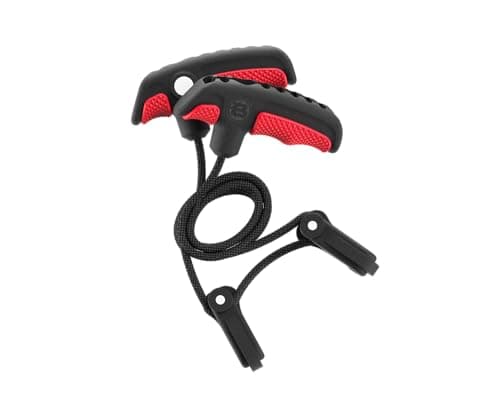
Place the stirrup on the ground and put one foot through it. Hook the cocking rope either side of the string, keeping the hooks square to the rail. Pull both handles straight up with even pressure until the string latches and you hear or feel the click. Engage the safety, then load the arrow.
With a rope cocker
Rope cocker procedure
- 01
Check the bow and the rope
Safety off the rail, no arrow loaded, string and rail waxed and lubed. Inspect the rope for fraying and the hooks for damage.
- 02
Set the stirrup
Rest the stirrup on firm, level ground and put one foot through it. Keep the bow vertical. The rail should point away from you and anybody else.
- 03
Center the rope on the stock
Lay the rope's center over the stock behind the latch so the two hooks hang evenly either side of the rail. An off-center rope is the main cause of an uneven cock.
- 04
Hook the string
Place each hook on the string, equal distances from the rail. Lift the hooks on rather than dragging them along the rail, which scuffs it.
- 05
Pull straight up, evenly
Stand up through the pull with both arms doing equal work. Do not pull one handle ahead of the other, and do not yank. Keep pulling until the string latches with a definite click.
- 06
Engage the safety and check the string
Engage the safety. Look at the string either side of the latch: the serving marks should sit symmetrically. If one side looks further back, de-cock and start again — an uneven cock sends the bolt out at an angle.
- 07
Remove the rope and load
Lift the hooks clear, stow the rope, then load the arrow against the retainer. With a half-moon nock, index the groove to the string.
With a cocking sled
The same procedure with one difference that matters: the sled's rigid frame engages the whole string at once, so there is no way to pull one side harder. Seat the sled squarely on the stock, check that the inserts are the right ones for your bow — Bear ships three with its aluminum sled — and pull straight up.
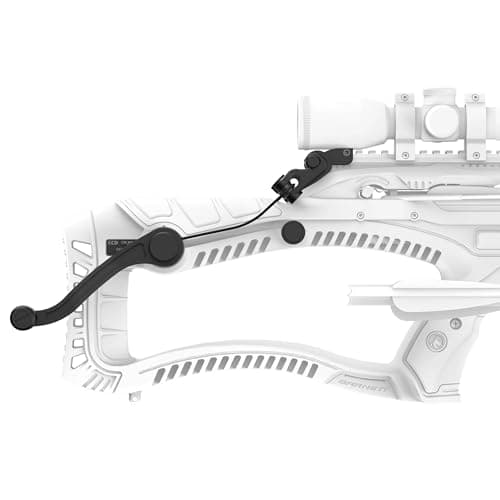
With a crank
Crank procedure
- 01
Confirm the crank is seated and the mount is tight
A loose crank mount turns the stock into a sounding board and can pull unevenly. Check it before every hunt, not just at the start of the season.
- 02
Set the stirrup or rest the bow
Most cranks let you cock seated with the bow across your lap or on a rest, which is the whole point. Keep the rail pointed somewhere safe.
- 03
Engage the claw or hooks on the string
Square to the rail, equal both sides, exactly as with a rope.
- 04
Wind at a steady pace
Do not rush it. On a system that lets you stop mid-stroke — TenPoint ACUslide, ACUdraw De-Cock, Ravin's one-way bearing — you can pause whenever an animal looks up. On any other mechanism, wind through in one go.
- 05
Stop at the latch
Wind until the string latches. Do not keep winding past the latch: over-drawing stresses the limbs.
- 06
Safety on, stow the handle, load
Engage the safety. Stow or detach the handle — a swinging handle is noise and a snag hazard. Then load the arrow.
The alignment check, which is worth doing every time
After the string latches, look at it. The serving should sit symmetrically either side of the latch, and most strings have center-serving marks you can use as a reference. If one side is visibly further back than the other, the bolt will leave at an angle. That is the cause of most fliers people blame on the arrow.
A rigid sled or a crank largely removes this problem. A rope cocker with an off-center start creates it.
Mistakes that cause real problems
- Cocking with an arrow on the rail. The arrow can be driven into the latch or your hand.
- Dry firing. Pulling the trigger on a cocked bow with no arrow. Every bow here has an anti-dry-fire mechanism and none of them is a guarantee.
- Dragging the hooks along the rail. Scuffs the rail and adds friction. Lift them on.
- Pulling unevenly. Fliers you cannot explain.
- Winding past the latch. Over-draws and stresses the limbs.
- Fingers above the flight deck. The string travels exactly there. This is the injury that actually happens.
When to cock, in the field
Cock on arrival at the blind or stand, before anything is in front of you — unless your bow lets you cock silently in stages, in which case you have the luxury of waiting. Then decide, before you climb up, how you will unload at the end. See how to de-cock a crossbow.
Frequently asked questions
How do you cock a crossbow with a rope cocker?
Can you cock a crossbow by hand?
How do you know when a crossbow is fully cocked?
Should you load the arrow before or after cocking?
Why does my crossbow shoot fliers?
Sources
Read next
Cocking Aids
How to de-cock a crossbow
Guides
Crossbow safety
Cocking Aids
The best crossbow cocking ropes
Cocking Aids
The best crossbow cocking devices