Guides
Crossbow safety
Four rules prevent almost every crossbow injury, and the first one is the one people forget in the moment that matters.
Four rules: keep your forward hand's fingers below the flight deck on every shot, never pull the trigger with no arrow loaded, never shoot an arrow lighter than the published minimum, and know what is behind your target. Those four prevent almost every crossbow injury.
Rule one: fingers below the flight deck
This is the injury that actually happens. The bowstring travels along the rail at exactly the height your forward hand's fingers want to curl up to, and it arrives at hundreds of feet per second. The consequences are severe and permanent.
Modern bows build in physical defenses: Barnett publishes a pass-through foregrip and finger safety reminders on the Wildcat, and Wicked Ridge publishes integrated safety wings that keep the shooter's hand and fingers safely below the flight deck plus a fully enclosed trigger guard. Use them, and build the habit anyway — a different bow may not have them.
Rule two: never dry fire
A dry fire is pulling the trigger on a cocked bow with no arrow loaded. All the stored energy — 175 to 220 lb of draw weight's worth — goes into the limbs with nothing to carry it away. It can destroy the bow outright and send parts in unpredictable directions.
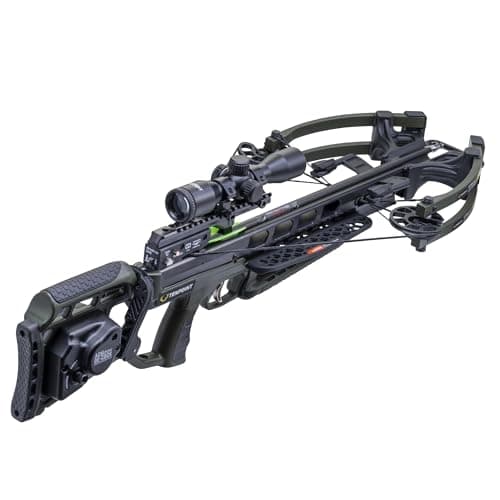
Every bow on this site has an anti-dry-fire mechanism, and none of them is a guarantee. Barnett publishes an anti-dry-fire nock sensor on the Hyper Raptor; TenPoint publishes a Dry-Fire-Prohibitor on the S2 trigger. Treat them as a backstop, not a license.
Rule three: respect the minimum arrow weight
Your bow publishes a minimum total arrow weight in its manual. An arrow lighter than that carries away less energy than the bow produces, and the remainder stays in the limbs. That is the dry-fire mechanism in miniature, on every shot — shorter string life, loosening hardware, and eventually limb damage.
Going heavier is almost always safe. Going lighter is the dangerous direction. See crossbow bolt weight.
Rule four: know what is behind the target
A crossbow bolt shot at an angle travels several hundred yards and arrives with enough energy to injure. A pass-through is possible on any shot — an under-rated target makes it likely, and a worn target face makes it more likely than a new one.
- Earth bank or hillside behind the target is the ideal backstop.
- Never a fence line with anything you cannot see beyond it.
- Never the ground alone at a steep angle — a bolt can skip off hard or frozen ground.
- Check the target's fps rating against your bow. See target stopping power.
Cocking and loading, in the safe order
The sequence
- 01
Cock the bow first, with no arrow loaded
Cocking with an arrow on the rail can drive it into the latch or your hand. Stirrup on firm ground, rail pointed somewhere safe. See how to cock a crossbow.
- 02
Engage the safety
Most bows engage it automatically when the string latches. Confirm it rather than assuming.
- 03
Load the arrow against the retainer
Index a half-moon nock's groove to the string. The arrow retainer — Barnett's Soft Lok floating bristle version is the named example here — holds it against the rail.
- 04
Keep the rail pointed somewhere safe, always
A cocked and loaded crossbow is a loaded weapon. Treat it exactly as you would a rifle.
- 05
Decide now how you will unload
Before you climb into the stand. A de-cocking system, or a discharge target you are carrying. See how to de-cock a crossbow.
De-cocking: what never to attempt
Do not try to release the string by hand, hold the string and pull the trigger, or backwind a crank whose maker does not publish de-cocking capability. The limbs hold a hundred and eighty pounds or more of stored energy and it will go somewhere. Use a de-cocking system, or fire a bolt into a target.
In a treestand
- Use a haul line. Never climb with a cocked bow. Climb first, haul the bow up uncocked.
- Wear a harness. This is a treestand rule rather than a crossbow rule and it is the one that saves lives.
- Cock the bow in the stand, seated, with the rail pointed out and down.
- Plan the descent. Unload before you climb down, and lower the bow on the haul line.
Storage
- Uncocked, always, and makers advise against leaving a bow cocked for extended periods.
- Separate from arrows, and ideally locked, especially with children in the house.
- Dry. Moisture against the rail and hardware starts corrosion. See crossbow maintenance.
Inspect before you shoot
Any of these means stop:
- Fraying or separation at the string's center serving.
- Any crack, split or delamination in a limb.
- A carbon shaft that creaks or feels soft when flexed — flex-test every bolt, every shot.
- A cracked nock, or one that fits loosely.
- A loose scope mount, quiver bracket or limb bolt.
Hunter education and the law
Many states require a hunter-education certificate, and crossbow-specific rules vary by state — including minimum ages, supervision requirements and whether a permit is needed for archery season. Check your own wildlife agency's current regulations. See crossbow hunting regulations.
Frequently asked questions
What is the most important crossbow safety rule?
What happens if you dry fire a crossbow?
Can you climb a treestand with a cocked crossbow?
Is it safe to leave a crossbow cocked?
How far does a crossbow bolt travel if it misses?
Sources
Read next
Cocking Aids
How to cock a crossbow
Cocking Aids
How to de-cock a crossbow
Guides
Crossbow maintenance

Targets & Cases
Will a crossbow shoot through a target?