Scopes
Crossbow scope reticles, explained
Dots, crosshairs, chevrons and electronic points. Each is better at something, and the differences matter most in the light you actually shoot in.
String & Stock earns a commission when you buy through our links, at no extra cost to you. Prices come from Amazon and change; the date beside every price is when we last verified it. Full disclosure.
Ranked
Quick picks
| # | Product | Reticle | Score | Price |
|---|---|---|---|---|
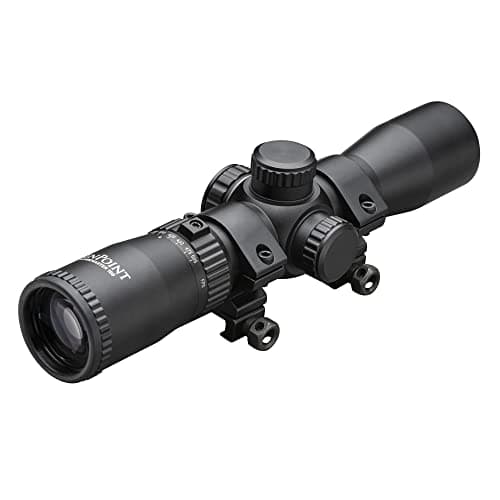
| Rank 1 | TenPoint RangeMaster 100 | Etched glass, 3 illuminated dots at 20/30/40 yd, 3 crosshairs at 50/60/70 yd | 8.8 | $299.99Amazon |
| Rank 2 | 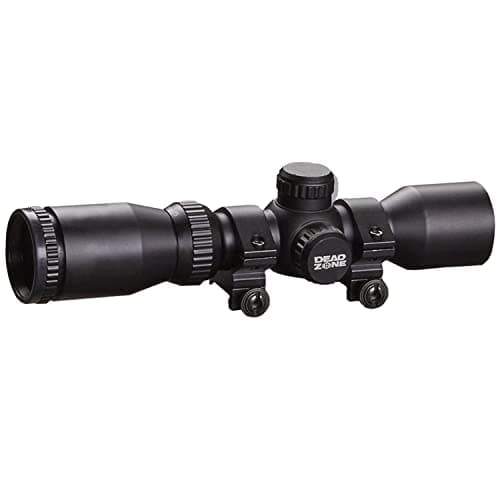 Excalibur Dead Zone | Excalibur chevron | 8.0 | $119.99Amazon |
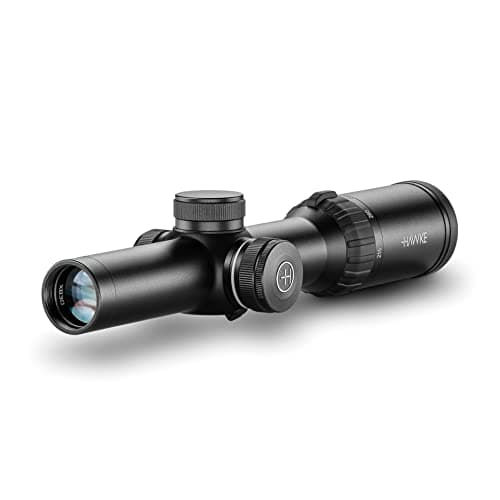
| Rank 3 | 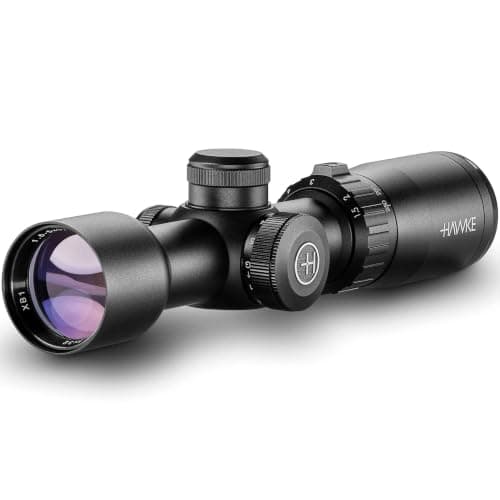 Hawke XB1 SR 1.5-5x32 | XB1 SR, red and green illuminated | 8.7 | $159.99Amazon |
| Rank 4 | 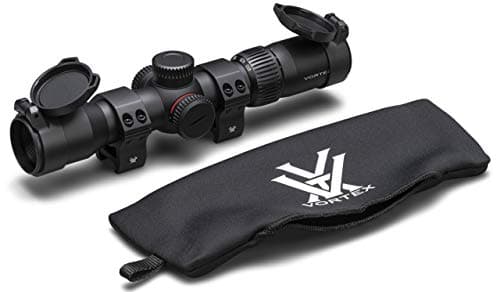 Vortex Crossfire II 2-7x32 Crossbow Kit | XBR-2, dual red and green illumination | 8.6 | $199.00Amazon |
| Rank 5 | 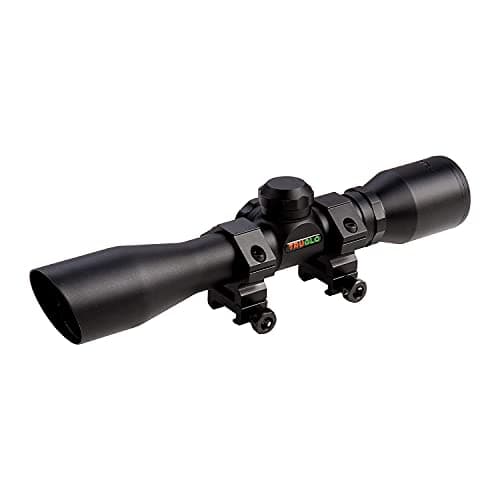 TRUGLO 4x32 Compact Crossbow Scope | BDC / rangefinder, bolt-drop compensating | 7.0 | $53.75Amazon |
Crossbow reticles come in four main patterns: stacked dots (fast, but a dot can cover the aiming spot), crosshair ladders (precise, harder to see in low light), chevrons (a point rather than a dot, so nothing is obscured), and electronic aim points (one correct mark, battery dependent).
A crossbow reticle has to do something a rifle reticle does not: show several holds at once, for a projectile that drops steeply. How a maker solves that is a real design choice with real consequences at dusk.
In detail
Scopes representing each reticle type
TenPoint RangeMaster 100
A 2-7x36 variable that accommodates 380 to 505 fps — the only scope here whose speed range starts where most others stop. Nine illuminated aim references on an etched-glass reticle: dots at 20, 30 and 40, crosshairs at 50, 60 and 70. If you bought a 430 or 470 fps bow, most crossbow scopes cannot be dialed for it. This one can.
| Published spec | Value |
|---|---|
| Speed range | 380-505 fps |
| Magnification | 2-7x |
| Objective | 36 mm |
| Max calibrated range | 100 yd |
| Reticle | Etched glass, 3 illuminated dots at 20/30/40 yd, 3 crosshairs at 50/60/70 yd |
| Weatherproofing | Water and fog proof |
| Zero procedure | Sight at 20 yd, micro-tune at 50 yd, zeroed at 100 |
What it does well
- 380-505 fps is the only range here that covers a 470 fps bow
- 7x at the top end is real magnification for a 100-yard hold
- Etched-glass reticle stays clean in the field of view
- 36 mm objective gathers more light than the 24 mm competition
Where it falls short
Our rubric
- 9.0
- 9.0
- 9.2
- 9.0
- 7.4
Excalibur Dead Zone
An adjustable speed dial from 300 to 410 fps driving Excalibur's chevron reticle from 20 to 60 yards. A chevron has a point rather than a center, which some shooters find faster to place on a deer's chest than a dot that covers the spot you are aiming at. The 60-yard ceiling is honest about crossbow range.
| Published spec | Value |
|---|---|
| Speed range | 300-410 fps |
| Tube | 1 in |
| Objective | 32 mm |
| Reticle range | 20-60 yd |
| Reticle | Excalibur chevron |
| Glass | Multi-coated |
| Rings | 1-inch rings |
What it does well
- The chevron point does not obscure the aiming spot the way a dot does
- A 20-60 yard reticle matches real crossbow shot distances
- Adjustable speed dial at a mid-budget price
Where it falls short
Our rubric
- 7.6
- 7.8
- 8.4
- 7.6
- 8.6
Hawke XB1 SR 1.5-5x32
Calibrated for 250 to 425 fps with 10-yard aim points running from a 20-yard zero all the way to 100, on 11-layer multi-coated glass. The no-fault lifetime warranty is the part worth noting: Hawke repairs or replaces it regardless of how it broke, which on a crossbow — a machine that recoils forward into its own scope — is not a trivial promise.
| Published spec | Value |
|---|---|
| Speed range | 250-425 fps |
| Magnification | 1.5-5x |
| Objective | 32 mm |
| Aim points | 20-100 yd in 10 yd steps |
| Reticle | XB1 SR, red and green illuminated |
| Glass | 11-layer fully multi-coated, System H2 |
| Warranty | No-fault lifetime repair or replace |
What it does well
- Aim points to 100 yards from a 20-yard zero
- Red and green illumination rather than one color
- No-fault lifetime warranty covers accidental damage
- Fast-focus eyebell and a high-torque zoom ring
Where it falls short
Our rubric
- 8.8
- 8.4
- 9.0
- 8.2
- 8.8
Vortex Crossfire II 2-7x32 Crossbow Kit
An XBR-2 reticle built around a 40-yard zero with holdovers from 20 to 100 yards, dual red and green illumination, and the Vortex VIP warranty: unlimited, unconditional, lifetime, transferable. The kit includes 30 mm rings, flip caps and a neoprene cover, so there is nothing else to buy.
| Published spec | Value |
|---|---|
| Magnification | 2-7x |
| Objective | 32 mm |
| Reticle | XBR-2, dual red and green illumination |
| Zero | 40 yd |
| Holdover range | 20-100 yd |
| Included | 30 mm rings, flip caps, neoprene cover |
| Warranty | VIP unlimited lifetime, fully transferable |
What it does well
- The best warranty terms on this site, and transferable
- The kit includes rings and caps, so the price is the whole price
- A 40-yard zero puts the holdovers where crossbow shots actually happen
- O-ring sealed and nitrogen purged
Where it falls short
Our rubric
- 8.0
- 8.6
- 8.8
- 8.4
- 8.6
TRUGLO 4x32 Compact Crossbow Scope
A one-piece aircraft-aluminum 4x32 with a bolt-drop-compensating reticle, nitrogen filling and weaver rings in the box. The spec worth noticing is 4 inches of eye relief: a crossbow fires forward into its own scope, and generous eye relief is how you keep the ocular off your eyebrow.
| Published spec | Value |
|---|---|
| Magnification | 4x |
| Objective | 32 mm |
| Eye relief | 4 in |
| Reticle | BDC / rangefinder, bolt-drop compensating |
| Tube | One-piece aircraft-grade aluminum, matte |
| Weatherproofing | Nitrogen filled, water and shock resistant |
| Included | Weaver-style scope rings, elastic lens caps |
What it does well
- 4 inches of eye relief, the most generous figure published here
- Rings included
- Leaf-spring fingertip windage and elevation adjustments
- Cheapest branded scope on the site
Where it falls short
Our rubric
- 5.4
- 7.0
- 6.8
- 6.4
- 9.0
Stacked dots
The most common pattern. A series of dots down the vertical axis, each one a distance. Fast to pick up, easy to understand, and the downside is physical: at 50 yards a dot subtends enough of the target to cover the spot you are aiming at. On a dark deer in poor light, you are aiming at a glowing circle over the vitals rather than at the vitals.
Crosshair ladders
Thin horizontal lines instead of dots. More precise, because you can see through the hold. Harder to see against a dark background unless illuminated, and a thin line at low brightness can disappear entirely.
Mixed, which is the best of both
TenPoint's RangeMaster 100 is the example here: three illuminated dots at 20, 30 and 40 yards, three illuminated crosshairs at 50, 60 and 70, and three further references beyond. Dots where speed matters — close, quick shots — and lines where precision does. Nine aim references on an etched-glass reticle, which stays clean in the field of view.
Chevrons
Excalibur's Dead Zone uses the brand's custom chevron reticle from 20 to 60 yards. A chevron is an upward-pointing V, and you aim with its apex. Nothing sits over the aiming spot, which some shooters find decisively faster to place on an animal's chest. It is a minority pattern and worth trying if dots have never felt right to you.
BDC without a speed dial
The TRUGLO 4x32's bolt-drop-compensating reticle has ranging marks and no speed dial, so it is calibrated for one assumed velocity. That is fine if your bow happens to match it and a source of unexplained misses if it does not. For a budget scope, prefer one with a dial — the Killer Instinct Lumix covers 270-450 fps for about the same money.
Electronic aim points
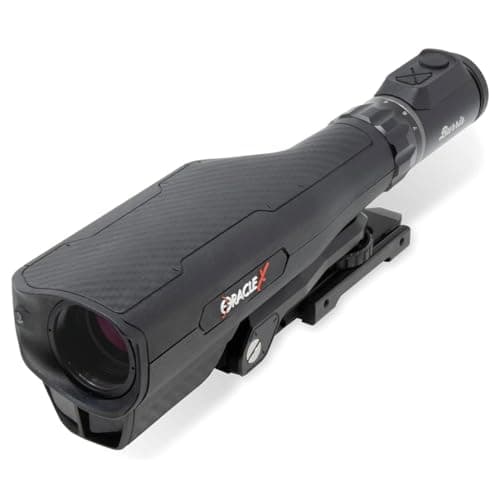
Burris's Oracle X and Garmin's Xero X1i show a single illuminated point at the corrected distance after ranging the target. No ladder, no estimating which dot to use, and no ambiguity. The costs are price, batteries and legality — see rangefinding crossbow scopes.
The comparison
| Pattern | Speed of use | Precision | Low light | Example |
|---|---|---|---|---|
| Stacked dots | Fast | Limited by dot size | Good when illuminated, can bloom | Vortex XBR-2, most bundled scopes |
| Crosshair ladder | Moderate | High | Needs illumination | Hawke XB1 SR |
| Mixed dots and crosshairs | Fast close, precise far | High | Good, etched glass | TenPoint RangeMaster 100 |
| Chevron | Very fast | High — apex is a point | Good | Excalibur Dead Zone |
| BDC, no dial | Fast | Only if speed matches | Varies | TRUGLO 4x32 |
| Electronic point | Fastest once ranged | Highest | Auto brightness | Burris Oracle X, Garmin Xero X1i |
Etched glass versus wire
An etched-glass reticle is laser-etched onto a glass element: thin, consistent, and it cannot shift or break. A wire reticle is physical wire, which can be thicker and in principle can move. TenPoint publishes etched glass on the RangeMaster and credits it with eliminating clutter. At this price point it is a meaningful upgrade.
First or second focal plane
On a second focal plane scope — the Vortex Crossfire II says so explicitly — the reticle stays the same apparent size while the target grows as you zoom. That means the holdover marks are only correct at one magnification. On a first focal plane scope the reticle scales with the image and the holds stay correct throughout.
For crossbow use this matters less than on a rifle, because most crossbow scopes have a narrow zoom range and the speed ring often shares the collar anyway. Set your magnification where the holds are calibrated and leave it.