How to choose
How to choose a crossbow
There are four decisions and they have an order. Get the first one right and the rest are preferences; get it wrong and you own a bow you stop shooting.
String & Stock earns a commission when you buy through our links, at no extra cost to you. Prices come from Amazon and change; the date beside every price is when we last verified it. Full disclosure.
Ranked
Quick picks
| # | Product | Cocking aid | Score | Price |
|---|---|---|---|---|
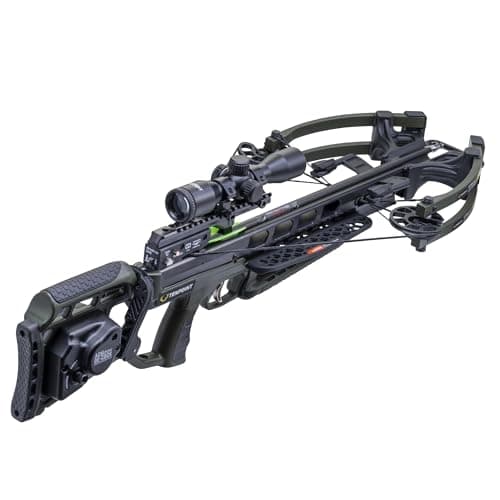
| Rank 1 | TenPoint Titan X De-Cock | ACUdraw De-Cock, integrated | 9.0 | $799.99Amazon |
| Rank 2 | 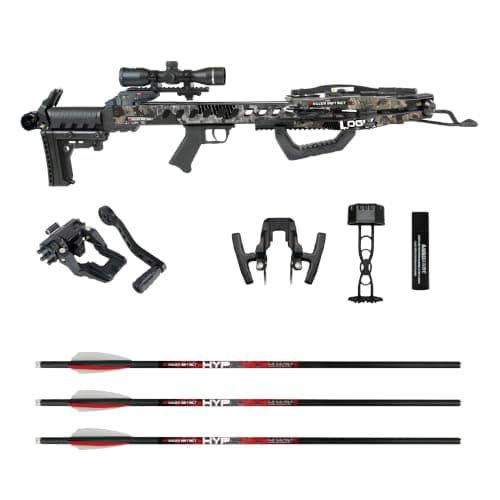 Killer Instinct LOGIX 435 | DSC crank on this package; sled rope cocker on the base kit | 8.8 | $529.99Amazon |
| Rank 3 | 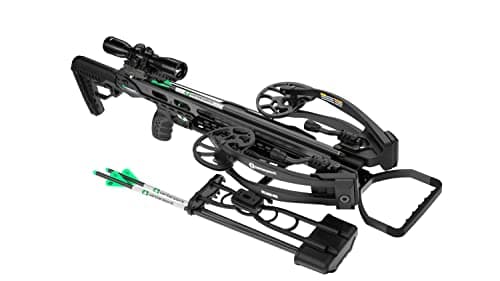 CenterPoint Hellion 400 | 8.3 | $339.95Amazon | |
| Rank 4 | 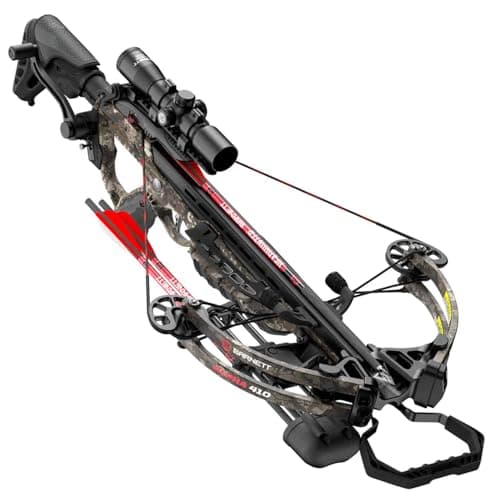 Barnett Alpha 410 | Crank cocking device, installed | 8.3 | $549.00Amazon |
Choose a crossbow in this order: how you will cock it, how wide it is cocked, what it weighs to carry, and only then how fast it shoots. Cocking effort is the decision that most often ends in an unused bow, and it is the one almost every buying guide puts last.
Most crossbow advice starts with speed because speed is the number on the box. In practice, the hunters who stop shooting a crossbow almost never stop because it was too slow. They stop because drawing it hurts, because it will not swing in the blind they hunt from, or because it is too heavy to carry to the place they wanted to hunt. Those are the three decisions that come first.
Decision one: how will you cock it?
A crossbow's draw weight is 150 lb to 220 lb. You are not lifting that full figure — a rope cocker halves it, a crank cuts it by roughly 90 percent — but the arithmetic is what decides whether the bow gets shot. Barnett publishes 93% reduction and 13 lb at the handle for its crank. TenPoint publishes 5 lb of cocking effort for its integrated systems. A 200 lb bow with nothing but a rope is a 100 lb lift, repeated, from a seated position.
- Integrated crank. Lowest effort, usually quietest, adds weight you cannot remove, slow for a second shot.
- Bolt-on crank. Nearly the same effort reduction for far less money, if a crank exists for your bow. See universal crank compatibility.
- Rope cocker. About 50 percent, weighs nothing, costs very little, keeps working when a gearbox does not.
- Sled. Same 50 percent with better string alignment, which matters for group size.
If you have a shoulder injury, are over about sixty, or simply know the lift is the problem, this decision is the whole purchase. The pages that go deeper are crossbow cocking effort explained and best crossbow for a shoulder injury.
Decision two: how wide is it cocked?
Cocked width is the span of the bow when drawn, and it is the only specification that can disqualify a bow outright. If you hunt from a pop-up blind, the window is commonly 12-16 in and you need room to swing, not just to fit. Published figures on this site run from 1.3 in to 15 in. Roughly a third of listings leave the number out entirely, which is its own answer. Cocked width and ground blinds has the measuring method.
Decision three: what does it weigh?
Bows on this site run from about 5.8 lb to 8.4 lb. That spread does not sound like much until you add a scope, a quiver, three bolts and a mile of walking in the dark. Weight is also the hidden cost of an integrated crank: the gearbox is on the stock permanently. If you hunt from a fixed stand a hundred yards from the truck, ignore this. If you pack in, see best lightweight crossbows.
Decision four: and now speed
Speed is a real specification and it is the last one. Modern bows run 280 to 470 fps, and above about 350 fps the practical effect for deer-sized game inside 40 yards is small. What speed genuinely buys is a flatter trajectory, which forgives a misjudged range, and more kinetic energy, which matters for larger animals. It also costs money, noise, and a target that can stop it. The honest version is on crossbow speed and fps.
In detail
Four bows that answer four different first decisions
TenPoint Titan X De-Cock
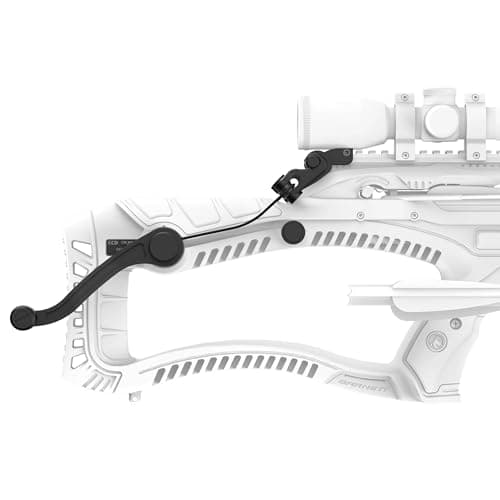
The de-cocking version of TenPoint's best-selling bow, and the most complete answer on this site to the question that brings most people here. The integrated ACUdraw De-Cock drops cocking effort to 5 pounds, and it backwinds, so you can unload the bow at the end of a sit without firing a bolt into the dirt. 400 fps and a 9.75-inch front end are the supporting cast.
| Published spec | Value |
|---|---|
| Speed | 400 fps |
| Cocking effort | 5 lb |
| Cocked width | 9.75 in |
| Cocking aid | ACUdraw De-Cock, integrated |
| De-cocks | Yes, backwind the handle |
| Trigger pull | 3.5 lb |
| Included | Pro-View 400 lighted scope, three Pro Elite 400 arrows, quiver, bow hanger |
What it does well
- 5 lb of cocking effort is the lowest figure any bow on this site publishes
- Safe de-cocking: the Auto-Brake gear system holds the handle wherever you let go
- A 9.75-inch front end clears blind windows and stand rails
- Ships assembled and pre-sighted, so first setup is a scope zero and nothing else
Where it falls short
Our rubric
- 9.6
- 8.4
- 8.5
- 9.0
- 7.8
- 8.6
Killer Instinct LOGIX 435
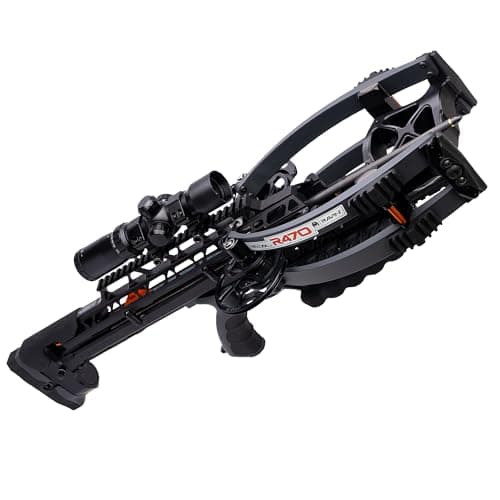
435 fps, 155.5 ft-lb, 6.75 inches cocked, and a LET-DOWN triggerbox that de-cocks the bow without a shot: numbers that read like a bow costing three times as much. The catch is the 210-pound draw weight and 7.9-pound carry weight. Buy the package version with the DSC crank, because on a 210-pound bow the rope cocker is not a realistic long-term plan.
| Published spec | Value |
|---|---|
| Speed | 435 fps |
| Kinetic energy | 155.5 ft-lb |
| Cocked width | 6.75 in |
| Uncocked width | 10.75 in |
| Weight | 7.9 lb |
| Draw weight | 210 lb |
| Power stroke | 15 in |
| Overall length | 32.25-33.75 in |
| Trigger pull | 3.5 lb |
| Let-off | 56% |
| De-cocks | Yes, LET-DOWN triggerbox |
| Cocking aid | DSC crank on this package; sled rope cocker on the base kit |
| Scope | Illuminated glass-etched Lumix 4x32 |
| Included | Three 20 in 390 gr Hypr bolts, five-arrow quiver, rail lube |
| Warranty | Limited lifetime on non-wearable parts |
What it does well
- 6.75 in cocked is narrower than anything else here outside Ravin
- De-cocking on a budget bow, which is close to unheard of
- 435 fps and 155.5 ft-lb are the highest published figures in the Killer Instinct range
- Full spec sheet published: both widths, let-off, trigger pull and power stroke
Where it falls short
Our rubric
- 8.8
- 9.6
- 7.6
- 9.4
- 7.0
- 9.0
CenterPoint Hellion 400
8 inches cocked, 12 uncocked, 400 fps off a 185-pound draw, for the price of a mid-range scope. It is the narrowest bow on this site under five hundred dollars, which makes it the budget answer to the blind-window problem. Note that it requires CP400 lighted nocks.
| Published spec | Value |
|---|---|
| Speed | 400 fps |
| Draw weight | 185 lb |
| Cocked width | 8 in |
| Uncocked width | 12 in |
| Limbs | Compression fiberglass quad |
| Arrows | Three 20 in .003 straightness arrows |
| Nocks | Requires CP400 lighted nocks |
What it does well
- An 8-inch cocked width is the narrowest here outside the Ravin line
- A 185-pound draw is lower than its rivals at the same speed
- Roller retention spring and CNC aluminum rails at a budget price
Where it falls short
Our rubric
- 6.6
- 8.4
- 7.8
- 9.6
- 8.0
- 9.0
Barnett Alpha 410
Barnett ships this one with the crank cocking device already installed, which is the thing most bows at this price make you buy separately. Add the illuminated multi-reticle scope, quiver, arrows and lube and it is a complete first setup with no cocking-aid decision left to make.
| Published spec | Value |
|---|---|
| Cocking aid | Crank cocking device, installed |
| Scope | 4x32 illuminated red/green multi-reticle |
| Arrows | Two 20 in Headhunter carbon, 100 gr points |
| Quiver | Lightweight side-mount, 3 arrow |
| Included | String and rail lube wax |
| Speed | |
| Cocked width |
What it does well
- The crank comes installed, not boxed separately or sold as an accessory
- Complete package: scope, quiver, arrows, wax
- Multi-reticle illuminated scope at a mid-range price
Where it falls short
Our rubric
- 8.8
- 8.4
- 7.6
- 7.6
- 7.6
- 8.8
The decision ladder
Start with the sentence that sounds most like you.
- Cocking is the problemAn integrated crank with a published effort figure, and de-cocking if you hunt alone See the picks
- My blind window is tightA published cocked width of 10 inches or less; measure the window first See the picks
- I walk a long way inUnder 6.5 pounds, and think hard about whether you want a gearbox on the stock See the picks
- I am hunting elk or bearA published kinetic-energy figure and the heavy end of the arrow range See the picks
- This is my first crossbowA complete package with scope, bolts and a cocking aid in the box See the picks
What the four picks above are each for
| If this is you | Pick | Why |
|---|---|---|
| Cocking effort decides it | TenPoint Titan X De-Cock | 5 lb published effort, and it unloads itself |
| You want energy and specs | Killer Instinct LOGIX 435 | 155.5 ft-lb, 6.75 in cocked, de-cocks, budget price |
| The blind window is tight and money is short | CenterPoint Hellion 400 | 8 in cocked and 12 in uncocked, both published |
| You want a crank in the box under $600 | Barnett Alpha 410 | Crank installed, scope, arrows and quiver included |
Specs that matter less than they look
- Draw weight on its own. It tells you nothing useful until you pair it with the cocking aid. A 185 lb bow with a crank is easier to live with than a 150 lb bow without one.
- Power stroke. Real physics, but it is already baked into the speed figure the maker publishes.
- Included broadheads. Package broadheads are practice points in all but name. Budget for real ones.
- Camo pattern. Costs money, changes nothing. The Barnett Alpha 410 and its camo siblings are the same bow.
The short version
- Decide how you will cock it, and buy the published effort figure.
- Measure your blind window, and buy a published cocked width with margin.
- Weigh the walk in.
- Then pick a speed, and buy a target rated above it.